
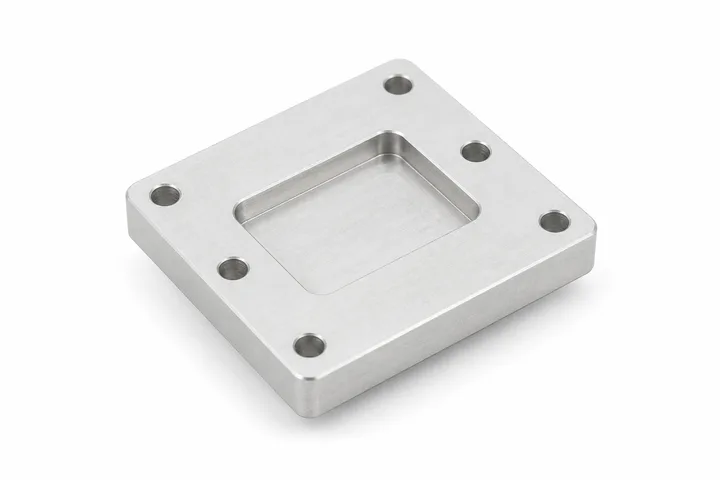
Aluminum sensor bracket
Aluminum 6061-T6 · 50 × 40 × 10 mm · 3-axis milled · 6 holes, 1 pocket · as-machined · ±0.1 mm general
$92 total
$194 total
$760 total
Cost Guide
Most cost guides say “it depends.” This one shows the numbers — real example prices from the FabDigit quote engine, what moves them, and how to design the cost out before you upload.
Three reference parts, priced through the same engine that quotes every FabDigit order. Watch what quantity does to the unit price — that pattern repeats on almost every machined part.
Aluminum 6061-T6 · 50 × 40 × 10 mm · 3-axis milled · 6 holes, 1 pocket · as-machined · ±0.1 mm general
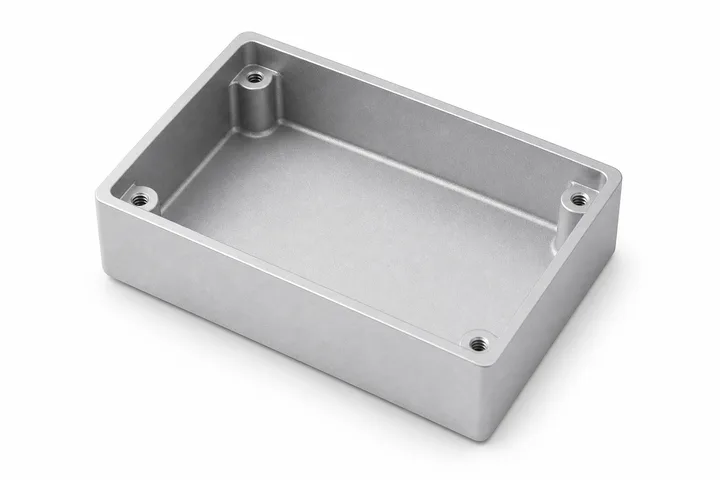
Aluminum 6061-T6 · 120 × 80 × 40 mm · deep pocketing, M3 tapped holes · bead blast · ±0.05 mm on bores
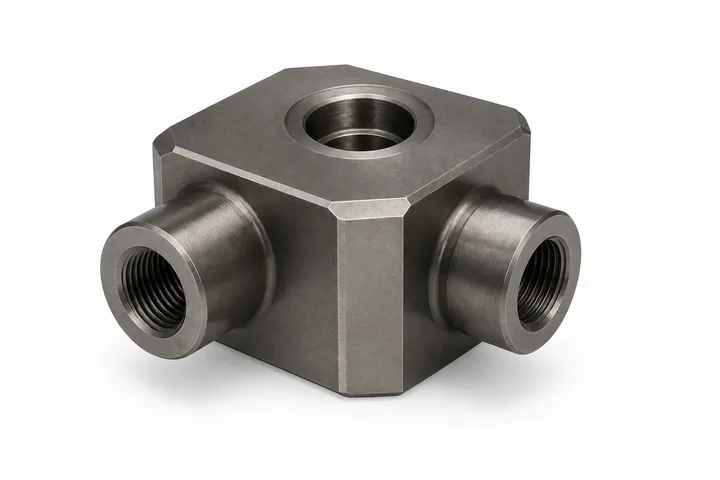
Titanium Ti-6Al-4V (Gr 5) · 60 × 60 × 35 mm · 5-axis · sealing faces at ±0.025 mm · as-machined
Example prices were sampled from the live FabDigit quote engine in September 2026 for the exact reference geometries described, then rounded. They are shown for comparison, not as quotes — your part is priced on its own geometry and confirmed by engineering review before production.
Four line items explain nearly every CNC price — but their shares shift dramatically with quantity. At one part, setup and programming is most of what you pay; by a hundred parts it fades to single digits and machine time plus material take over. The bars below show the mix for the aluminum sensor bracket priced above.
Card figures show each driver’s share of the unit price moving from quantity 1 to quantity 100:
58% → 7%
Setup & programming
CAM programming, fixturing, and first-piece inspection cost the same whether you order 1 part or 100. At one part it IS most of the price; at a hundred it nearly disappears.
30% → 57%
Machine time
Spindle minutes are the biggest slice once setup amortizes. Deep pockets, small internal corners, and 5-axis setups all buy more minutes.
7% → 26%
Material
You pay for the stock block your part is cut from, not the part volume. Exotic alloys flip this: titanium or PEEK stock can dominate the price.
0–100%+ adder
Tolerances & finishes
Every callout tighter than ±0.05 mm adds slower passes and more inspection. Anodize, powder coat, and plating add lot charges.
Relative machined-part cost with aluminum 6061-T6 as the baseline. Note that the multiplier is rarely just the stock price — hard and gummy alloys also machine slower.
| Material | Typical cost vs 6061 | Why |
|---|---|---|
| Delrin (POM) | 0.8–0.9× | Cheap stock, machines fast, no work-hardening. The budget pick for jigs and non-structural parts. |
| Aluminum 6061-T6 | 1.0× (baseline) | The default CNC material: cheap stock, excellent machinability, anodizes well. |
| Aluminum 7075-T6 | 1.1–1.2× | Aerospace-grade strength; stock costs more than 6061, cuts nearly as fast. |
| Brass C360 | 1.1–1.3× | Expensive stock but the fastest-machining metal on the list — the two mostly cancel out. |
| Steel 4140 | 1.3–1.5× | Tougher on tooling, slower feeds; often needs post-machining heat treatment. |
| Stainless 304 | 1.4–1.6× | Work-hardens as you cut it — slower speeds and more tool wear than mild steel. |
| Stainless 316L | 1.5–1.8× | Gummier than 304; the marine/medical corrosion premium is machine time, not just stock. |
| PEEK | 2–3× | The stock itself is the cost: engineering-plastic billet priced like a specialty alloy. |
| Titanium Ti-6Al-4V | 2.5–4× | Expensive stock AND slow machining (low thermal conductivity limits cutting speed). |
Tightening one bore does not reprice the whole part — but a blanket title-block tolerance does. Typical impact on the affected features:
| Tolerance band | Typical price impact | What changes in the shop |
|---|---|---|
| ±0.1 mm and up (general) | Baseline | Standard milling and turning operations, standard inspection. |
| ±0.05 mm | +5–15% | Slower finishing passes, tighter tool-wear management. |
| ±0.025 mm (precision) | +15–30% | In-process metrology, temperature-stable machining windows. |
| ±0.01 mm and tighter (critical) | +40–100%+ | Grinding, EDM, or lapping as secondary operations; CMM verification on the feature. |
Finishing is usually billed per lot, not per part — which makes it nearly free at quantity 100 and noticeable at quantity 1.
| Finish | Typical adder | Notes |
|---|---|---|
| As-machined | Included | Sharp edges broken, visible tool marks. Ra 1.6–3.2 µm typical. |
| Bead blast | +$10–25 / lot | Uniform matte texture; hides tool marks before anodizing. |
| Anodize Type II (clear or color) | +$40–90 / lot | Corrosion + cosmetic layer for aluminum; lot charge dominates at low quantity. |
| Anodize Type III hardcoat | +$90–160 / lot | Wear-resistant 25–50 µm layer; masking for tight-tolerance bores adds cost. |
| Powder coat | +$60–130 / lot | Thick cosmetic/protective layer; check tolerance stack on mating faces. |
| Laser marking (part IDs, logos, data matrix) | Free at FabDigit | Included at no extra cost on eligible parts. |
Look back at the sensor bracket: $92 for one piece, $7.60 each at a hundred — a 92% lower unit price for the same geometry. Nothing about the part changed; the fixed setup cost (CAM programming, fixturing, first-piece inspection) simply spread across more parts. Most of that collapse happens early: the jump from 1 to 10 pieces routinely cuts unit price by 70–80%, while 10 to 100 adds another 50–60%.
Aluminum sensor bracket — unit price by quantity
Practical rule: if you need 8 parts, price 10. If a revision is likely, prototype at 1–3 first — the setup you “waste” on a scrapped revision is far cheaper than 100 obsolete parts.
Straight from the DFM checks our engineers run on every quote. Each one is a design decision, not a negotiation.
Simple machined parts start around $90–100 for a single prototype and drop to a few dollars per part at 100+ pieces. A small aluminum 6061 bracket sampled through the FabDigit quote engine prices at about $92 for one piece, $19 each at 10 pieces, and under $8 each at 100 pieces. Machine time, setup amortization, material, and tolerances are the four drivers that move that number.
CAM programming, fixturing, and first-piece inspection cost roughly the same for 1 part as for 100. At quantity 1 that fixed setup cost IS most of the price; at 100 it spreads to pennies per part. That is why unit price typically falls 75–90% between quantity 1 and quantity 100.
Aluminum 6061-T6 is the cost baseline for metals — cheap stock and excellent machinability. Delrin (POM) machines even cheaper for non-structural plastic parts. Stainless steels run roughly 1.4–1.8× the price of 6061, and titanium 2.5–4×.
Moving from a general ±0.1 mm tolerance to ±0.05 mm typically adds 5–15% on the affected features. ±0.025 mm adds 15–30% with in-process metrology, and ±0.01 mm or tighter can add 40–100% or more because it usually requires grinding or EDM plus CMM verification. Tolerances are priced per feature — only the callouts you tighten cost extra.
Upload your CAD file to FabDigit for an instant quote — the same pricing engine that produced the example numbers in this guide reads your geometry, material, tolerance callouts, and quantity, and returns a price in minutes. Every order is then confirmed by an engineering review before production.
No. They are real price points sampled from the FabDigit quote engine for the three fixed reference geometries described, rounded for readability, and shown so you can compare cost drivers. Your part is priced on its own geometry, and engineering review confirms every order before production.
Upload a CAD file and the same engine behind this guide prices your geometry in minutes — with an engineering review before anything hits the floor.